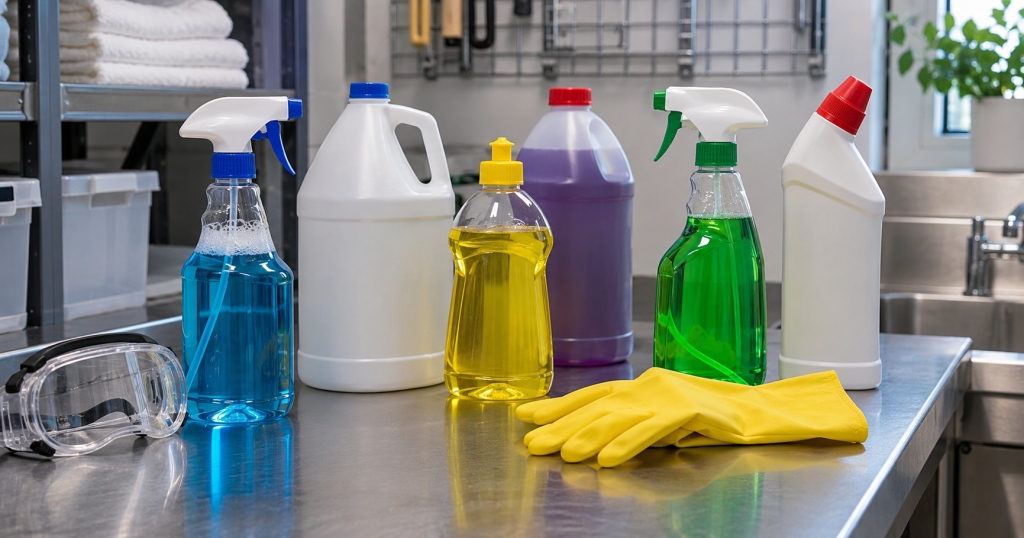
A bathroom stain will not come out. Someone reaches for a second cleaner, thinking two products must work better than one. In a commercial space, a maintenance worker may make a similar decision while trying to finish a difficult job. What began as routine cleaning can suddenly become a chemical hazard.
Mixing cleaning chemicals can release dangerous gases, create corrosive substances or trigger other reactions. The problem may not end when the initial fumes disappear. If the products and resulting substances are unknown, determining whether an area needs further assessment or cleanup can become much more complicated.
For homeowners and businesses in Calgary, the safest approach is simple: do not combine cleaners or chemicals. Follow the manufacturer’s label and use only specifically approved dilution or preparation methods.
Why Mixing Cleaning Products Can Be Dangerous
Cleaning products are formulated for particular purposes. A product that is effective on its own does not become safer or more effective when combined with something else. Health Canada explicitly advises against mixing household chemical products because some combinations can produce harmful gases.
These examples are warnings, not a complete list of unsafe combinations. Brand names, packaging, and familiar household uses do not establish that two products are compatible. Even products marketed as natural or environmentally friendly still need to be used according to their labels.
When a Cleaning Mistake Becomes a Chemical Hazard
A chemical reaction may be noticeable through unexpected fumes, breathing irritation, heat or damage to nearby surfaces. However, people should not rely on smell, colour or a visible stain to identify a substance or decide that an area is safe.
The immediate danger depends on what was mixed, the amount involved, how the substances reacted, the setting and whether people were exposed. An enclosed room can present a different risk from a larger open area. Some exposure symptoms can also develop or worsen after the initial incident. The same distinction between appearance and contamination also matters in our article on hidden biohazard risks after a tenant leaves, where visible conditions may not reveal the full problem.
Not every accidental mixture causes extensive contamination or property damage. But where the substances are unknown or a hazardous release is suspected, adding another product or attempting an improvised cleanup can make a difficult situation worse.
Why Unknown Chemical Mixtures Complicate Cleanup
Mayken has reported encounters with clients who combined products without knowing the consequences. In those situations, the remediation question is not simply how to remove the remaining stain. It is what substances are present, how they may behave and whether further intervention is safe.
The original product names, containers, labels and Safety Data Sheets (SDS) can help qualified responders assess a release. CCOHS recommends using SDS information and technical data to establish chemical hazards and plan an appropriate response. When the materials cannot be identified confidently, a specialist assessment may be necessary before any remediation approach is chosen.
Depending on the incident, responders or specialists may need to consult a poison centre, chemical experts or an analytical laboratory. Laboratory testing is not automatically required for every cleaning mishap, and the appropriate decision belongs to qualified professionals familiar with the conditions.
Some emergencies require fire or hazardous-materials responders rather than an ordinary cleaning crew. Mayken’s potential role is in subsequent hazardous cleanup where the conditions have been assessed and the work falls within its confirmed capabilities.
How Improper Cleanup Can Increase the Damage
One wrong assumption can add to the work. Spreading an unidentified substance with a mop or another cleaning product could move contamination into additional areas or create a new chemical reaction. Depending on the material and the chemical involved, liquid contamination may also reach joints, cracks or absorbent building materials.
That is why a clean-looking surface does not always settle the question. In particular cases, the response may involve assessment of affected materials, removal of unsalvageable components, specialized disposal or documentation of the work performed. These measures are not inevitable; the actual scope depends on what happened and what qualified assessment establishes. For property owners facing uncertain conditions, our guide to signs a rental property needs more than standard cleaning explains why routine cleaning may not be the appropriate first step.
The financial consequences can extend beyond the original cleaning task. Restricting access to a room, arranging specialized evaluation or replacing damaged materials can all add time and expense. An attempt to make a cleaner work harder may therefore result in a much larger problem than the stain it was meant to remove.
Chemical Mixing Risks for Businesses and Cleaning Companies
Commercial cleaners, custodial staff, property managers and maintenance contractors may handle several products during a shift. Unlabelled bottles, unfamiliar chemicals and rushed changeovers can create opportunities for mistakes.
CCOHS advises workplaces to understand each product’s hazards, consult its label or SDS, provide appropriate training and use products only as directed. The safest practice is to select the right cleaner for the job rather than combine different ones. Any dilution must follow the manufacturer’s approved directions and concentration; workers should never improvise mixtures.
A workplace procedure should make it clear who responds to an incident, how workers report suspected chemical exposure, where product information is kept, and when personnel must withdraw and call emergency services. Staff should not be expected to investigate unknown fumes or clean an uncontrolled release without proper training and equipment.
What to Do if Cleaning Chemicals Have Already Been Mixed
If a mixture produces unexpected fumes, causes irritation or may have created a hazardous release, treat it as a safety issue rather than a stubborn cleaning problem.
Leave the affected area and keep others away. Do not approach the mixture to inspect or smell it.
Do not add another chemical, try to neutralize the mixture or attempt to clean up an unknown hazardous substance.
For an active hazardous-materials emergency in Calgary, call 911 from a safe location and follow the emergency responders’ instructions. The City of Calgary advises evacuation for a hazardous indoor spill.
For possible exposure to chemicals in Alberta, contact the Poison and Drug Information Service (PADIS) at 1-800-332-1414, available 24 hours a day. Call 911 for an immediate medical emergency.
Tell responders which products may have been involved. Share product names, labels or SDS information if already available, without re-entering a hazardous area to retrieve them.
Do not assume that opening windows, activating fans or returning once an odour fades is safe in every incident. Follow directions from emergency personnel, poison specialists and the relevant authorities for the situation.
How Professional Assessment Helps Determine the Next Step
After the immediate hazard is controlled, the next step may be determining what remains. The original products, affected surfaces, possible routes of spread and any emergency response findings can influence whether further cleanup is needed. For more on how professionals approach assessment once a release is controlled, see our article about what happens after a chemical spill is contained.
A qualified assessment may find that a limited response is sufficient, or that more extensive work is necessary. CCOHS emphasizes that chemical spill response depends on the material, the nature of the release, and the training and equipment available. There is no single cleanup method suitable for every unknown mixture.
Mayken Hazmat Solutions provides hazardous cleanup and environmental spill remediation services. For an incident involving an unknown mixture, the company would need to evaluate the circumstances and determine whether it can take on the remediation, whether additional testing or specialist input is needed, or whether the matter should remain with emergency or other qualified responders.
Preventing Chemical Mixing Accidents at Home and Work
The simplest way to avoid an accidental reaction is to make product instructions the starting point for every cleaning task. Keep products in their original labelled containers, do not mix different cleaners, and use the right product for the intended surface. Where a manufacturer provides instructions for dilution, follow the approved method and concentration exactly.
Businesses should also keep accessible product information, train workers in safe handling, avoid transferring chemicals into unlabelled containers, and review emergency procedures before an incident occurs. The same principle applies to homeowners: more products do not necessarily mean a cleaner or safer result.
A Cleaning Shortcut Should Never Become a Safety Risk
Mixing cleaning chemicals can turn an ordinary task into an exposure hazard and, in some circumstances, an expensive property-cleanup problem. The biggest challenge may be that nobody knows exactly what was created or how it should be handled.
Do not experiment with chemical combinations. Follow product directions, act promptly when an unexpected reaction occurs, and leave hazardous releases to qualified responders. Once an emergency is controlled, Mayken can be contacted to discuss whether specialist hazardous cleanup assessment or remediation is appropriate for the property.