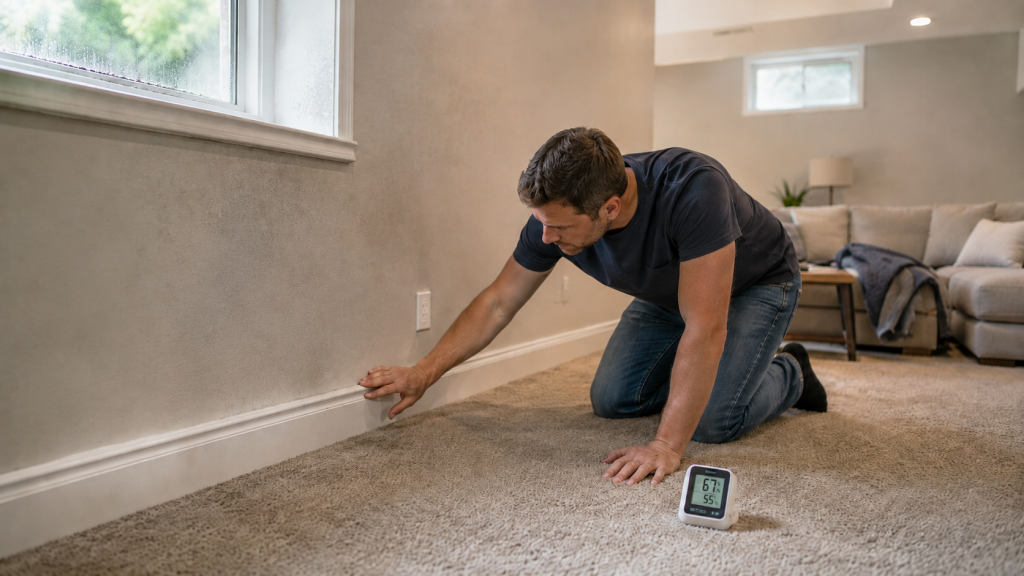
You open the basement door after a warm day and notice stale, earthy air. The windows get opened, the smell fades, and a day later it is back.
A musty smell in a house is not a diagnosis. It is a clue. The useful question is not only, “How do I make this room smell better?” It is, “What is producing the odour, what material is holding it, and how is it moving through the home?”
Summer can make an existing issue easier to notice. Higher humidity, closed rooms, basement dampness, and changing airflow can bring hidden moisture or absorbed odours to the surface. The smell may become more noticeable, even though the underlying problem may have been present for weeks or months. Finding the source is what changes the outcome.
Jump To:
The Smell Is a Signal, Not Proof of Mould
Musty and earthy odours are often linked to dampness and mould, but smell alone cannot tell you what is present, how much is affected, or where the source sits.
Health Canada advises homeowners to check for stains, discolouration, damp areas, and a musty or earthy odour. It also notes that mould may be concealed inside walls, above ceilings, or within drywall, insulation, fabric, and wood.
Two opposite mistakes are common. Some people assume every musty room has a major mould problem. Others assume the smell is harmless because no mould is visible.
Neither conclusion is reliable. A better response is to track how the odour behaves.
Why Summer Can Make a Hidden Issue More Obvious
Summer does not create every musty odour. It can reveal one that was already developing.
Basements and lower levels often remain cooler than the outdoor air. Moisture may collect on cold surfaces, while rain, irrigation, plumbing leaks, poor drainage, or earlier water entry can leave building materials damp.
Health Canada recommends maintaining indoor relative humidity between 30% and 50%. Ventilation, exhaust fans, air conditioning, and dehumidifiers can help, but leaks and wet materials still need to be addressed directly.
A hygrometer may show acceptable humidity in the centre of a room while a wall cavity, carpet underlay, or cabinet base remains wet. The room reading tells you about the air near the device. It does not rule out moisture in one part of the structure.
Three Practical Clues to Narrow the Source
When someone asks, why does my house smell musty, the answer often starts with three observations.
1. Location
Where is the odour strongest?
A smell near a floor drain, exterior wall, bathroom vanity, window, or carpet edge gives more useful information than “the basement smells.” Check adjoining rooms too because airflow can move odour away from the source.
2. Timing
When does it get stronger?
An odour that increases after rain may point toward water entry. A smell that appears when the furnace fan or air conditioner runs may be travelling through shared airflow. One that builds after a room has been closed may be held in porous materials.
3. Property History
What happened before the odour started?
A past leak, long vacancy, tenant turnover, pet damage, pest activity, severe clutter, or unfinished repair can change the risk profile. The smell may be new to you even when the source is not.
These clues do not confirm the cause, but they help separate a minor humidity issue from a condition that needs closer assessment.
Think in Terms of Source, Material, and Pathway
Recurring odour usually involves more than the air itself. Look at three parts.
Source: What is producing the smell?
Possible causes include dampness, mould, sewage, pet urine, spoiled organic material, rodent waste, smoke residue, or chemical contamination.
Material: What is holding it?
Carpet, underlay, drywall, insulation, unfinished wood, furniture, concrete, and ceiling tiles can absorb moisture or contamination.
Pathway: How is it reaching the room?
Odour may move through gaps, vents, floor cavities, plumbing openings, stairwells, or shared air systems.
This is one reason deodorizing often fails. A spray may change the air for a short period, but it does not remove a wet carpet pad, contaminated subfloor, or mould-affected wall cavity.
The smell can return because the source, the affected material, or the pathway was never addressed.
Common Sources Routine Cleaning May Miss
Moisture Behind Finished Surfaces
Slow plumbing leaks, foundation seepage, roof leaks, and condensation can affect materials before staining becomes obvious.
Drywall may look intact while its paper backing remains damp. Carpet may feel dry while the underlay holds moisture.
Canada Mortgage and Housing Corporation notes that dampness inside a material can be enough for mould growth. A musty or earthy smell may be one of the warning signs.
Absorbed Organic Contamination
Pet urine, spoiled food, animal nesting, sewage, and bodily fluids can soak into porous materials. Cleaning the visible surface may not reach the layer below.
This can happen during difficult rental turnovers, estate cleanouts, and properties affected by severe clutter. Mayken’s article on signs a rental property needs more than a standard cleaning explains how odour or contamination can remain under flooring, behind appliances, or inside soft materials.
Mould That Keeps Returning
Health Canada separates mould growth into small, medium, and extensive categories.
Small areas on cleanable surfaces may be manageable with proper precautions. Larger or recurring growth, especially following a major leak or flood, calls for trained remediation support. The moisture source must still be corrected, or the growth may return.
Property History Can Change the Response
A musty smell does not prove drug residue, biohazard contamination, or pest waste.
Still, known drug activity, abandonment, hoarding, sharps, biological waste, or heavy pest activity means the property should not be treated like a routine cleaning job.
For landlords, Mayken’s guide to hidden risks after a tenant leaves provides a practical inspection framework before cleaners, maintenance staff, or contractors enter.
What You Can Check Without Making the Problem Worse
Start with low-risk observations:
- Note the rooms, surfaces, and times when the odour is strongest.
- Check under sinks, around toilets, near exterior walls, beside windows, and along carpet edges.
- Look for swelling, peeling paint, staining, soft drywall, condensation, or damaged caulking.
- Confirm that bathroom, kitchen, and dryer vents discharge outdoors.
- Use a hygrometer to track humidity over several days.
- Review recent leaks, water entry, vacancy, pest issues, or tenant concerns.
- Avoid opening walls, lifting contaminated flooring, or disturbing unknown residue without knowing what is present.
Do not mix cleaning products to chase an odour. Do not paint over the area before the source has been identified.
If occupants experience persistent irritation, breathing concerns, or worsening asthma that may be connected to dampness or mould, Health Canada advises speaking with a health care provider.
When Specialized Odour Treatment May Be Needed
The key threshold is persistence combined with evidence.
An assessment may be appropriate when:
- The odour returns shortly after ventilation or cleaning.
- The smell is concentrated near walls, flooring, vents, or cabinets.
- There is visible mould, water damage, or repeated condensation.
- Porous materials were wet and did not dry quickly.
- The home has a history of flooding, sewage, hoarding, animal waste, drug activity, or prolonged vacancy.
- The affected area is large or returns after cleanup.
- The property must be cleared for tenants, sale, restoration work, or contractor access.
- The source may involve hazardous or biological material.
Mayken’s article on when to call a biohazard cleanup company helps clarify when an odour may be part of a larger contamination concern rather than a normal maintenance issue.
What Source-Based Treatment Should Accomplish
Good odour work should answer four questions:
- What is causing the odour?
- Which materials are affected?
- What can be cleaned, and what may need removal?
- What condition must be corrected to reduce recurrence?
The work may involve moisture assessment, containment, removal of affected materials, cleaning, decontamination, targeted odour treatment, and documentation. The process depends on the source and affected materials.
Mayken’s property cleaning and remediation services address odours linked to mould, pests, hoarding, drug contamination, and other difficult property conditions. Chemical or hazardous sources may require a different process through environmental and hazardous cleanup and disposal.
This is not simply cleaning. It is source-based remediation designed to address the underlying cause.
An Illustrative Property Scenario
A basement room smells musty each afternoon. The carpet has been cleaned twice, and a dehumidifier lowers the room humidity, but the smell returns.
The strongest odour is near one exterior corner. The baseboard shows slight swelling. The homeowner recalls a downspout overflow during heavy rain months earlier.
The carpet may be holding the smell without causing it. The next step is to inspect the wall edge, underlay, subfloor, drainage, and exterior water path before spending more on deodorizing.
Pattern-based assessment turns “the room smells bad” into a clearer decision.
Treat the Cause Before the Odour Becomes the Project
A musty smell in a house should not trigger panic, but repeated odour deserves more than fragrance and guesswork.
Track where it appears, when it changes, what materials may be involved, and what happened in the property before the smell began.
The key takeaway is simple: odour is evidence of a condition, not the condition itself.
Mayken Hazmat Solutions helps homeowners, landlords, property managers, and estate contacts assess odour and contamination concerns in Calgary. Review Mayken’s services, or contact Mayken to discuss the property and next steps.